Status of Firearm Related Bills in the 2026 Legislative Session

The anti-civil rights bills are flooding in and both gun owners and the firearms industry are facing unprecedented attacks in Virginia.

Some of the most egregious bills being proposed are:

For a complete list of all bills impacting gun owners and the firearms industry and what their current status is, please see the Bill Tracker I maintain for the Virginia Citizens Defense League (VCDL) and sign up for the VA-ALERT email updates.

Posted in 2A, AR-15, Assault Firearms, Concealed Handgun Permit, FFL Issues, Magazine Capacity, Second Amendment, Suppressors, Virginia Concealed Handgun Permit, Virginia Law, Virginia Politics | Comments Off on Status of Firearm Related Bills in the 2026 Legislative Session

Private Transfer of NFA Items to Your Trust

This guide will walk you through every step of the process to do a private transfer of individually owned or trust owned NFA items to your NFA Trust and make it as easy as possible.  The fields referenced are based upon the December 2025 revision of the Form 4.  As new revisions of the form are released, I will update this guide.

Getting Started

The Form 4 is available for download from the ATF website.  You should save it to your computer and open it with Adobe Reader or your preferred PDF editor on your computer (rather than editing it in your browser or on a phone or tablet where the built in automations will NOT work correctly) then it will auto-copy the data you type into the ‘ATF Copy’ to the ‘Registrant Copy’ and the ‘CLEO Copy’.

Form 4 – Page 1

  • Box 1 will be checked for $0 unless you are transferring a machinegun or destructive device.  The changes that took place in 2025 and went into effect on January 1, 2026 from the Big Beautiful Bill removed the excise tax on all other NFA items.
  • Box 2 should contain the name of your trust (exactly as it appears on the header of the trust document) and the mailing address for the location where the item will initially be stored.
  • In Box 2 you should also check the box for TRUST.
  • Box 3a should contain the name of the current registrant (exactly as it appears on the current tax stamp) and the owner’s current mailing address.
  • Box 3b should contain the owner’s email address.
  • Box 3c should contain owner’s telephone number.
  • Box 3d and 3e should usually be left blank (if there is a decedent involved then a Form 5 might need to be completed and you should call me to discuss).
  • Boxes 4a through 4h should be copied directly from the current tax stamp.
  • Unless the registrant has an FFL listed on the original tax stamp (very rare), then boxes 5, 6, 7, and 8 should be left blank.
  • Sign your name in Box 9.  Important:  The ATF requires all signatures to be in either blue or black ink.
  • Box 10 should contain the current registrant’s name (as it appears on the current tax stamp) followed by “- SELF” if owned individually or “-TRUSTEE” if currently owned in a trust.
  • Box 11 should contain the current date.

Form 4 – Page 2

  • Box 12 should contain the information about your CLEO.
  • Box 13 should have the name of your trust in the first blank and ‘all lawful purposes‘ in the second blank.
  • Box 14, 15, 16, 17, 18 and 19 should be left blank.  For trust applicants, these background questions and photos will be part of a separate form for each ‘responsible person’ (Form 23) for which I will provide instructions further down in this guide.
  • On the bottom of Page 2 sign your name and add “as trustee” at the end then enter the date in the accompanying field.  Important:  The ATF requires all signatures to be in either blue or black ink.

Form 4 – Page 3

  • Box 20 should contain the number of responsible persons on your trust.  I have a detailed article here laying out which persons on your trust are considered ‘responsible persons’ but the short answer is that you are a responsible person and so are those people listed on Schedule B of your trust.  If you want to remove joint trustees from your Schedule B before submitting your application, I have a guide to doing so here.
  • Box 21 should contain your full legal name and the full legal names of all those on Schedule B of your trust.
  • Box 22 should contain your method of payment and, if you are paying with a credit card, the information about the credit card and the amount being paid.  You only need to sign in Box 20 if you are paying with a credit card.  Important:  The ATF requires all signatures to be in either blue or black ink.

Turning to the Form 23

A copy of the new ‘responsible person’ form 5320.23 (Form 23) will need to be completed by each ‘responsible person’ of the trust listed in Box 21 of the Form 4.

Important Note:  Your fellow ‘responsible persons’ will find it much easier to complete this form if they have a copy of the completed Form 4 in front of them.  

The Form 23 may be downloaded from the ATF website. It is well designed with fillable fields which auto-transfer the data to additional copies (this only works if you use a PDF editor on your computer instead of on your browser, phone, or tablet).  I will instruct you where to send each copy later in this guide.

You, and any Joint Trustees listed on Schedule B of your trust, should download the form and each one must complete it according to the following instructions:

Form 23 – Page 1

  • In Box 1 you should check the box for Form 4.
  • In Box 2 you should copy the trust name and address from Box 2 on the Form 4.
  • In Box 3a you should put your full legal name and your home address.
  • In Box 3b you should put your telephone number.
  • In Box 3c you should put your email address.
  • If you have changed your name at any time during your life, including being married, then Box 3d should contain all other names you have ever used.
  • In Box 3e you will affix a 2×2 passport-quality photo taken within the last year (on the ATF copy of the form only).  As I noted here, many NFA dealers offer in-store photography options so you should check with your local gun store.  Failing that, Walgreens is a common provider of this service in many towns.
  • Box 3f should contain your Social Security Number.  This is an optional field but including it should dramatically decrease your processing time.
  • Box 3g should also contain your date of birth.
  • Box 3h should contain your ethnicity
  • Box 3i should contain your race
  • In Box 4a, you should copy the type-of-firearm from the Form 4
  • In Box 4b you should copy the mfg/maker/importer name and address from the Form 4
  • In Box 4c you should copy the model from the Form 4
  • In Box 4d you should copy the caliber and UOM from the Form 4
  • In Box 4e you should copy the serial number from the Form 4
  • Box 5 should contain the information regarding the CLEO whose jurisdiction includes the home address in Box 3a of this form.

Form 23 – Page 2

  • You will need to answer the questions in Boxes 6, 7, 8, and 9 as they apply to you, the person completing the form.  You will need to answer them truthfully as any errors may be prosecuted as perjury!
  • Note: If you have been convicted of a felony but have since had your gun rights restored then the instructions state you should answer question ‘No’ to the question about whether you have been convicted of a felony.  However, I strongly advise you to attach a copy of your restoration paperwork to the Form 23 when submitting it to the ATF.
  • You will sign the certification following Box 9.  (More about this in the signing section below)
  • You should enter the date in the field to the right of the signature block.

Printing The Completed Form 23

Once you have completed the Form 23, you will need to print it.  It will print 2 copies.  You should now affix your photo to the ATF copy of the Form 23 only. (DO NOT USE STAPLES)

Signing the Completed Form 23

The only place you will need to sign the Form 23 is following the certification statement below Box 9.  You do NOT add “as trustee” to your signature on this form.

Do not forget to sign both copies of the Form 23.

Important:  The ATF requires all signatures to be in either blue or black ink.

Notifying Your CLEO

The Settlor of the trust will need to mail his or her CLEO (From Box 5 of the Form 23) the CLEO copy of the Form 4 and the CLEO copy of their Form 23.

All other responsible persons (in the rare event you have them) will only need to mail his or her CLEO (From Box 5 of their Form 23) the CLEO copy of their Form 23.

Important Note:  The CLEO copy of the Form 23 does not have a photo affixed.  You should also not send fingerprint cards to the CLEO.

Fingerprint Cards

Each Form 23 to be sent to the ATF will need to be accompanied by fingerprints of the responsible person taken on TWO FBI (FD-258) fingerprint cards.  As I noted here, many NFA dealers offer in-store fingerprinting so you should check with your local gun store.  Failing that, you should be able to get fingerprinted at your local law enforcement agency.  No matter who does the fingerprinting, you should make sure that they use the correct FD-258 cards.

Mailing the Completed Form 4 Packet to the ATF

Now we need to prepare the packet to mail to the ATF.  Note that If you are building more than one NFA item, you will need a separate packet for each item.

This packet should include:

  • The first 2 copies of the completed Form 4 with original signatures in blue or black ink on both copies.  (These are marked ATF Copy and Registrant Copy on the bottom of the forms)
  • The ATF Copy of the Form 23 for each responsible person of the trust (in the rare event you have them) with photos affixed and fingerprint cards included. (DO NOT STAPLE)
  • A single copy of your notarized trust instrument (including all schedules and amendments)
  • Payment for the amount of the tax ($200) (if machinegun or destructive device) payable to BATFE (unless you entered credit card info on the Form 4)

The entire packet should be mailed to:

National Firearms Act Division
Bureau of ATF
PO Box 5015
Portland, OR 97208-5015

If this guide leaves any questions unanswered, please feel free to contact me.

Posted in 41F, ATF, BATFE, CLEO Notification, FAQ, Form 4, NFA Transfers, NFA Trusts, Tax Stamp | Comments Off on Private Transfer of NFA Items to Your Trust

What should an FFL do if a firearm that is being shipped to them is lost in transit?

I was recently contacted by an FFL I represent who had a post-sample machinegun being shipped to him that was lost in-transit.

He wanted to know what his responsibilities were versus those of the manufacturer / shipping FFL.

While this was an NFA item (National Firearms Act), the steps one should take when a firearm is lost in-transit is largely the same for NFA items and regular firearms, with a few additions noted below.

First, within 48 hours of discovering the loss, an ATF Theft/Loss Report (Form 3310.11) must be filed by the shipping FFL (required by 27 CFR 478.39a).

The completed form can be submitted by email to [email protected] or faxed to (304) 616-4501.  Receipt of the form should be confirmed by calling the ATF at (888) 930-9275.

Second, the shipping FFL should report the loss to their local police or sheriff’s department since the shipping location is deemed to be where the loss occurred. They will need to obtain a case number or incident report number because the ATF will typically require proof that the loss was reported to local law enforcement.

The shipping FFL should also file a loss claim through the carrier. They should maintain all correspondence with the carrier in case the ATF or local law enforcement requests the documentation.

Important Note: The receiving FFL should ask for a copy of the ATF Form 3310.11, the incident report # from the local law enforcement, and any correspondence from the carrier claim.

Finally, the FFL the item was being shipped to, who never received the item, should document the transfer in their A&D (Acquisitions and Dispositions) book as shipped, but lost in-transit, and reference the ATF Form 3310.11 submission and the other associated details (incident #, etc.).

Additional Steps For NFA Items

In this case, the lost firearm was an NFA item, specifically a post-sample machinegun, the loss of which the ATF takes very seriously, and the NFA Branch will need to be notified.  The shipping FFL should call them immediately at (304) 616-4500, reference the Form 3 control number, and describe the exact circumstances of the loss.

If there is any question in the mind of the receiving FFL whether the shipping FFL has taken any of these steps, they should contact the ATF themselves out of an abundance of caution.


Posted in ATF, ATF Form 3310.11, BATFE, FFL Issues, Form 3, Loss of Firearm, NFA Transfers, Shipping Firearms | Comments Off on What should an FFL do if a firearm that is being shipped to them is lost in transit?

What is the current status of the bill attempting to remove suppressors from the NFA?

NOTE:  I will keep this post updated as the bill moves throughout the legislative process.

————————————————–

Update – July 2, 2025

With Vice President JD Vance casting the tie-breaking vote, the Senate passed the revised version of the bill that includes the revised Section 70436 described in my June 29 update below.

The bill now goes back to the House where they can either accept the changes as-is or modify the bill further and send it back to the Senate.

While Gun Owners of America and other gun-rights groups are encouraging the House to re-add the full NFA repeal for suppressors and short-barreled rifles and shotguns, this would almost certainly result in the bill not making it to the President’s desk by his self-imposed deadline of July 4th so the chances of that happening appear slim.

————————————————–

Update – June 29, 2025

After the Senate Parliamentarian removed the HPA and SHORT Act provisions of the ‘Big Beautiful Bill’ as violative of the “Byrd Rule”, the latest revised version of the bill has brought the issue back into the bill in a modified form.

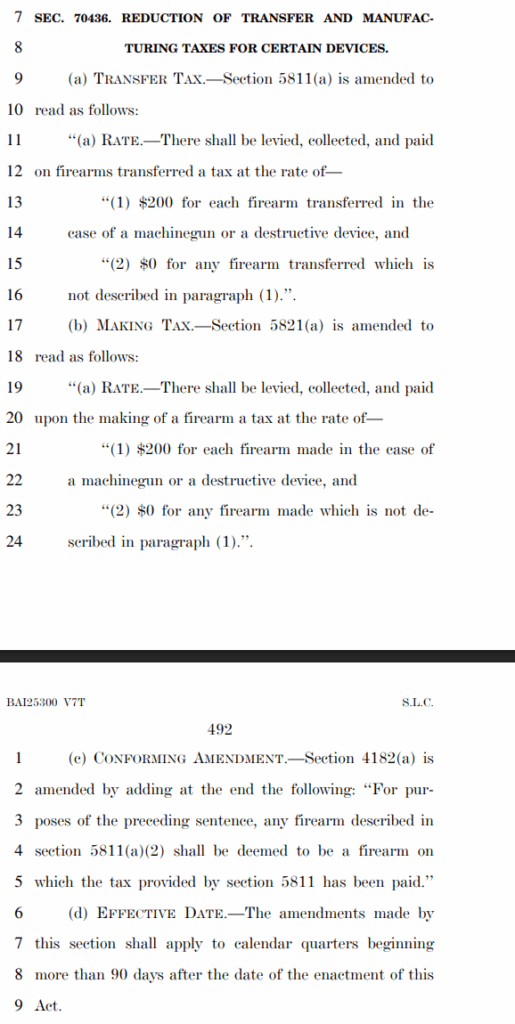
Section 70436 leaves suppressors, short-barreled rifles, and short-barreled shotguns subject to all current NFA requirements, including registration and transfer limitations, but removes the $200 transfer tax for all NFA items except machineguns and destructive devices.

————————————————–

Update – June 28, 2025

The Senate Parliamentarian has removed the HPA and SHORT Act provisions of the ‘Big Beautiful Bill’ as violative of the “Byrd Rule”.

The “Byrd Rule” refers to the fact that budget reconciliation matters (such as this bill), when being considered by the Senate, may be approved by a simple majority instead of 60 votes to avoid a filibuster.  However, only certain provisions may be included in a bill for it to take advantage of this process.

Despite the courts upholding the NFA multiple times over the years on the basis that it is not a gun control measure but rather a tax, the Parliamentarian ruled that the NFA related provisions (among many others) were not appropriate to be included in this bill under the Byrd Rule.

The Senate has 3 options at this point:

  1. Accept the recommendation of the Parliamentarian and pass the bill without the HPA and SHORT Act provisions;
  2. Add new provisions that keep the items on the NFA but reduce or eliminate the transfer tax; or
  3. Remove the Parliamentarian.

I do not believe that will choose option 3 for political reasons.  Therefore, I suspect the best we can reasonably expect is option 2 … and the Republicans may choose to avoid the issue altogether in order to meet their self-imposed goal of passage by July 4th.

————————————————–

Update – June 17, 2025

The bill has been modified in the Senate to include the totality of the SHORT Act which removes SBRs, SBSs, and AOWs from the NFA and preempts state law regarding their ownership.

————————————————–
Update – June 17, 2025

The bill has been modified in the Senate to add Section 3 of the original Hearing Protection Act which reads as follows:

SEC. 3. Treatment of certain silencers.

Section 5841 of the Internal Revenue Code of 1986 is amended by adding at the end the following:

“(f) Firearm silencers.—A person acquiring or possessing a firearm silencer in accordance with chapter 44 of title 18, United States Code, shall be treated as meeting any registration and licensing requirements of the National Firearms Act with respect to such silencer.”.

This section is designed to mitigate the issue I described below in bullet point 4 and which is discussed in the video I embedded.

————————————————–

The original version of President Trump’s ‘One Big Beautiful Bill’ included a provision which eliminated the National Firearms Act (NFA) tax on suppressors but left them subject to the other provisions of the NFA.

In a subsequent amendment, which was approved by the House of Representatives, suppressors were removed from the NFA altogether.

But being approved by the House does not guarantee that version of the bill will become law.  Now that it has passed the House, it must be voted on in the Senate.  Often, the Senate will pass a different or modified version of a bill and then there has to be a conference committee convened to resolve the differences. So, the final version may be one of these two options or something else altogether.

Once both chambers have passed the bill, and any changes have been reconciled, the final version will be sent to the President to be signed or vetoed.

Some common questions I have been asked:

1) If passed, when will the bill become effective?

If signed by the President, the bill will become law and will be effective based upon the effective date laid out in the bill.  The current version of the bill has this language regarding the effective date of the suppressor changes:

“(d) Effective Date.–The amendments made by this section
shall apply to calendar quarters beginning more than 90 days
after the date of the enactment of this Act.”

So … for example … if the bill was signed into law on July 4, then 90 days would take us to October 2.  The quarter that starts after that date is the 1st quarter of 2026 which starts January 1.  Therefore, if the current language survives the Senate, the bill would become effective January 1, 2026.

2) What will happen to those suppressors already registered under the NFA?

That is a good question that will probably not be answered until the ATF promulgates regulations following the enactment of the final bill.

3) Will there be refunds for those suppressors already registered under the NFA?

The bill does NOT provide for the refunding of previously paid excise taxes under the NFA.

4) If I currently live in a state that only allows suppressors if they are owned in compliance with the NFA, will I lose my suppressor?

That is a very interesting question.  Attorney Tom Grieve has done a detailed breakdown of this issue on his YouTube channel.

Short answer … at least in the short term, there will almost certainly be collateral consequences in some states.


Posted in NFA Trusts | Comments Off on What is the current status of the bill attempting to remove suppressors from the NFA?

Understanding the status of forced reset triggers in Virginia

UPDATE:  I have been receiving questions and comments from concerned gun owners, and I have added additional analysis below based upon their questions and feedback.

In an agreement between the government and Rare Breed Triggers, announced Friday May 16th, 2025, the Department of Justice agreed that the Bureau of Alcohol, Tobacco, Firearms and Explosives overstepped its authority in reclassifying forced reset triggers (FRTs) as machine guns and will return any such items seized or surrendered to them.

While this is great news for gun owners at the federal level, it doesn’t necessarily solve the issue for those in Virginia.  In fact, it potentially sets a legal trap for the unwary.

Please note that I am NOT making a definitive statement that FRTs are covered under Virginia’s ‘trigger activator’ statute but rather pointing out that the statute is vague enough, and inadequately describes complex mechanical processes, such that it could subject owners to legal issues.

In the 2020 session, the General Assembly added section 18.2-308.5:1 to the Code of Virginia, which made it unlawful for any person to ‘manufacture, import, sell, offer for sale, possess, transfer, or transport an auto sear or a trigger activator in the Commonwealth.

In this code section, “trigger activator” is defined as “a device designed to allow a semi-automatic firearm to shoot more than one shot with a single pull of the trigger by harnessing the recoil energy of any semi-automatic firearm to which it is affixed so that the trigger resets and continues firing without additional physical manipulation of the trigger by the shooter.”  This definition can be interpreted broadly and presents significant potential legal threats to those who might own FRTs.

The most common question I have received is whether FRTs are even covered by this statute since they do not operate via ‘recoil energy’.   Let’s look at that question:

  1. Is there a definition of ‘recoil energy’ in this code section?  No
  2. Is there a definition of ‘recoil energy’ in the Code of Virginia? No.
  3. Is there a definition of ‘recoil energy’ in the VA Administrative Code? No
  4. Is there a definition of ‘recoil energy’ in Virginia case law? No
  5. Is there a definition of ‘recoil energy’ in Federal case law? No
  6. Is there a definition of ‘recoil energy’ in Black’s Law Dictionary? No

Therefore, under the rules of statutory construction, we will look to the standard definition of the term which is the backward force generated when a firearm is fired, equal to the force generated by the powder charge that propels the bullet forward.

So do FRTs use this ‘backward force’?  In a 2022 Open Letter to All Federal Firearms Licensees, the BATFE stated this about how FRTs function:

Unlike traditional triggers and binary triggers … FRTs do not require shooters to pull and then subsequently release the trigger to fire a second shot. Instead, these FRTs utilize the firing cycle to eliminate the need for the shooter to release the trigger before a second shot is fired. By contrast, some after-market triggers have similar components but also incorporate a disconnector or similar feature to ensure that the trigger must be released before a second shot may be fired.

The key question then is whether a prosecutor, judge, or jury, many of whom might not be familiar with firearms, would find that the ‘firing cycle’ is a part of, or analogous to, the ‘recoil energy’ of the shot.

THIS is the legal risk that I am warning my clients about with this article.

And while those who own registered pre-ban auto sears are protected by a clause in the new law that exempts those items owned “in compliance with the National Firearms Act”, I believe that there are statutory construction issues where FRTs are concerned since they are not regulated under the NFA, as recognized in the aforementioned settlement.

The second most common question I have been asked is whether subsection D of the law, exempting those items owned in compliance with the National Firearms Act (NFA) would apply, since FRTs are no longer considered machineguns in violation of the NFA and are therefore not subject to any requirements of the NFA.

My answer is that it opens yet another door where a prosecutor could argue that being ‘in compliance’ with [X] means the item must be subject to AND compliant with [X].

See this video for a discussion of this specific issue and the competing arguments a prosecutor and defense attorney might make when facing such language in a state law.

This then sets the stage for law-abiding Virginia residents, hearing of the settlement with the DOJ, who attempt to have their seized or surrendered items returned to them, or who purchase such items from out of state vendors and bring them into the Commonwealth, being potentially prosecuted under the new law.

And the penalty for violation of this statute is prosecuted as a Class 6 Felony.

If you are a Virginia resident who had your forced reset trigger seized or voluntarily surrendered a forced reset trigger to the BATFE, and they contact you about returning said item, you should seek counsel before taking any action.

If you have questions or would like assistance with the forced reset trigger issue, then feel free to contact me for a consultation.

Posted in 2A, Administrative Law, ATF, ATF Ruling, BATFE, Court Rulings, Forced Reset Triggers, Machine Guns, Regulatory Rulemaking, Virginia Law | Comments Off on Understanding the status of forced reset triggers in Virginia